Featured High-Performance Architectural Systems
Precision-machined at our Foshan facility to address structural wind loads, high thermal differentials, coastal corrosion, and extreme seismic thresholds worldwide.
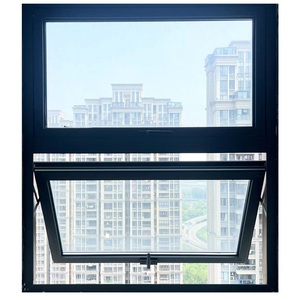
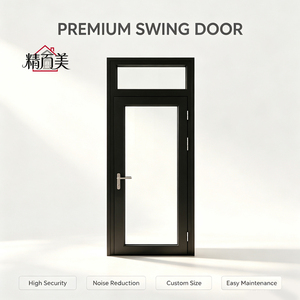
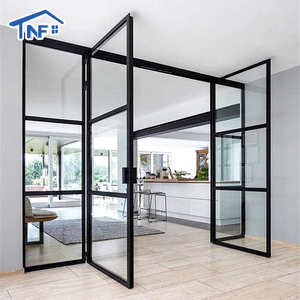
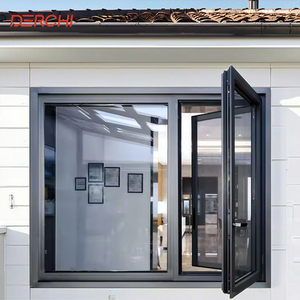
Intelligent Manufacturing Base
Engineering & Export Mastery
Highest Structural Wind Rating
Patents & Global Certifications
Why Global Engineering Consultants Select DERCHI
Recognized among China's Top 10 fenestration manufacturers, Guangdong Dejiyoupin Doors and Windows Co., Ltd. (DERCHI) bridges high-precision manufacturing with strict international code compliance.
180,000㎡ Mega Manufacturing Facility
Located in Nanhai District, Foshan, our production footprint houses advanced multi-axis CNC extrusion centers, automated multi-angle miter saws, precision casting units, and environmental powder-coating lines, guaranteeing industrial-scale output without dimensional deviations.
Triple-Continent Certification Protocols
DERCHI doors undergo rigorous laboratory destructive testing. We hold full CE markings, ISO 9001 quality audits, North American NFRC energy certifications, Australian AS 2047 N6 cyclonic testing, and UL fire-door ratings for institutional, hotel, and luxury residential projects.
Extreme Climate Engineering (50°C+ & Salt Air)
Engineered specifically for the intense ultraviolet radiation of the Middle East GCC, hurricane corridors in Florida and the Caribbean, and corrosive marine conditions. We deploy polyamide PA66 thermal barriers, fluorocarbon (PVDF) coatings, and 316 marine-grade stainless hardware.
Future Sourcing Trends & Technological Evolution (2025–2030)
Procurement in the architectural fenestration sector is shifting from commodity price comparison to life-cycle carbon calculations, thermal envelope metrics, and intelligent entrance automation.
Low-U-Value Multi-Chamber Extrusions
Global green building standards (LEED v4.1, BREEAM, Estidama Pearl) mandate entrance door U-values below 1.6 W/m²·K. DERCHI incorporates multi-chamber polyamide 66 nylon strips reinforced with 25% glass fiber (PA66 GF25), halting heat transmission during scorching summers and severe winters.
- Aerogel-infused insulated door cores
- Warm-edge silicone spacer assemblies
- Low-E argon-filled laminated insulated glass units (IGU)
Oversized Architectural Pivot Formats
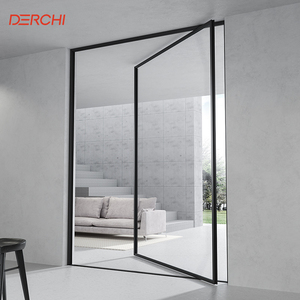
High-end residential villas and luxury hospitality properties are abandoning standard hinges in favor of floor-integrated hydraulic pivot mechanisms capable of carrying single leaves up to 4,000mm in height and 600kg in weight with fingertip operational resistance.
- Concealed bottom-closer with adjustable speed damping
- Multi-point motorized perimeter locking hooks
- High-tensile aviation-grade 6063-T6 aluminum alloys
Smart IoT & Concealed Access Integration
Modern commercial and residential procurement specifications integrate factory-embedded smart home protocols. Doors are now delivered with concealed conduit channels, biometric facial scanners, and electro-mechanical latch bolts compatible with KNX, Zigbee, and Control4 platforms.
- Concealed motorized deadbolts with fail-secure modes
- Integrated biometric touchsensors within pull handles
- Anti-tamper encrypted access signals
Technical Specification Matrix: Door Core & Profile Selection
Reference guide for project engineers, procurement consultants, and quantity surveyors comparing main door configurations.
| Door Core Architecture | Thermal Transmission (U-Value) | Acoustic Attenuation (Rw) | Wind Resistance / Load Class | Optimal Project Application |
|---|---|---|---|---|
| Thermally Broken Aluminum (PA66 Strip) | 1.2 – 1.8 W/m²·K | 38 dB – 44 dB | Class 4 / AS 2047 N6 (4500 Pa) | Coastal Luxury Villas, High-End Retail Storefronts |
| Solid Cast Aluminum Sculpted Panel | 1.8 – 2.4 W/m²·K | 42 dB – 48 dB | High Security / Impact Level E | Palace Entrances, Classic Estate Gates, Majlis Entrances |
| Marine-Grade 316 Stainless Composite | 1.5 – 2.0 W/m²·K | 40 dB – 45 dB | Extreme Impact / Forced Entry Class 4 | Sea-Facing Waterfront Estates, Heavy Security Compounds |
| Double/Triple Glazed Structural Glass | 1.1 – 1.6 W/m²·K | 36 dB – 42 dB | Hurricane Impact (TAS 201/202/203) | Modernist Villas, Executive Commercial Lobbies |
Frequently Asked Questions by Global Sourcing Officers
Addressing compliance, ocean logistics, factory CAD approval workflows, and climate resilience for overseas developers and contractors.
How does DERCHI ensure aluminum main doors will not warp under 50°C summer differentials?
Thermal expansion differential (the "Bi-Metal effect") occurs when the exterior surface reaches 75°C while interior air conditioning maintains 22°C. DERCHI mitigates this by utilizing crimped anti-distortion polyamide thermal break struts and split-profile engineering. This allows exterior and interior extrusion leaves to expand and contract independently without flexing the structural sash or compromising air-seal integrity.
What surface treatment specifications are applied for extreme coastal and salt-spray regions?
For installations within 5 kilometers of the shoreline (such as Dubai Palm Jumeirah, Miami, or Sydney Coastline), we employ Qualicoat Class 2 or Class 3 PVDF (fluorocarbon) multi-coat finishes with a minimum thickness of 40 microns, or 25-micron architectural anodizing. All lock cases, pivot pins, and concealed screws are standardized to AISI 316 stainless steel to ensure zero electrolytic pitting corrosion.
What is the engineering submittal and shop drawing sign-off process before manufacturing begins?
Our dedicated bilingual engineering office converts architectural elevations into comprehensive 2D CAD and 3D BIM shop drawings. These drawings delineate wall junction details, finished floor level (FFL) integration, sub-frame anchoring calculations, glass stress schedules, and drainage paths. Zero factory cutting occurs until the project consultant or architect signs and stamps the engineering package.
How are oversized pivot and cast aluminum entry doors packaged to prevent damage during sea transit?
DERCHI enforces a 5-layer export crating protocol: (1) Anti-static PE protective film on aluminum surfaces, (2) Edge corner perimeter impact foam, (3) Vacuum-sealed pearl wool wraps, (4) Internal steel-strapped skeleton, and (5) Non-fumigation plywood crates with shock indicators. Large pivot leaves are delivered with pre-welded lifting lugs to enable direct crane unloading on construction job sites.
Accelerate Your Project Specifications with DERCHI
Direct factory engineering consultation, comprehensive CAD/BIM shop drawings, and tailored Bill of Quantities (BOQ) estimates delivered within 24 hours.