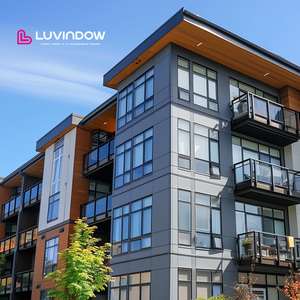
Architectural Specification Guide: Sourcing CE Certified Aluminium Balcony Fenestration Systems
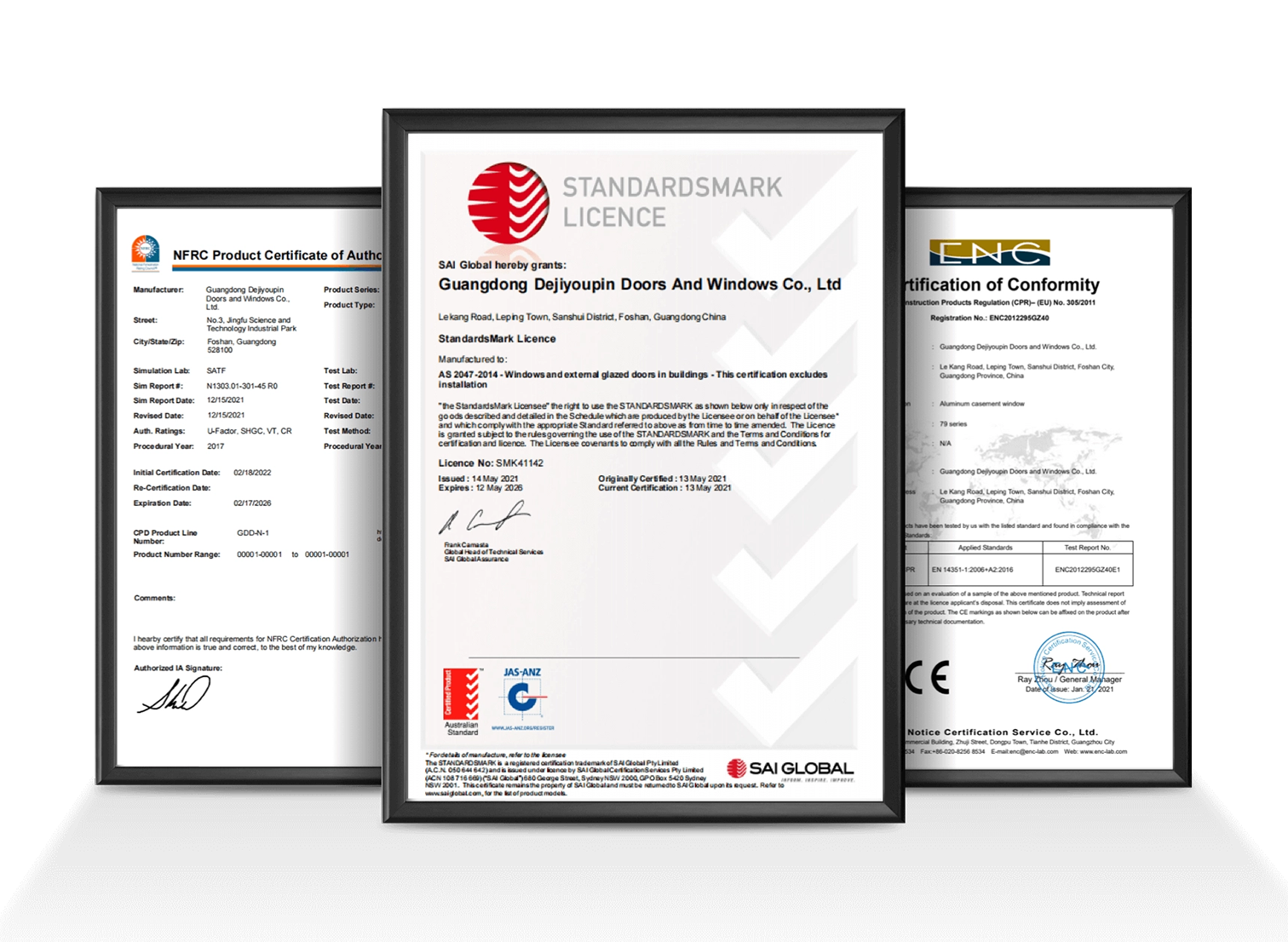
Modern residential and commercial envelopes demand exterior fenestration systems capable of withstanding turbulent microclimates while delivering pristine aesthetic integration. As an international fenestration engineer and export manufacturer, DERCHI engineers its aluminum balcony window systems to satisfy the harmonized structural criteria of the European Standard EN 14351-1, incorporating multi-cavity thermal barriers, advanced PA66 polyamide insulation strips, and precision hardware configurations.
Structural Integrity and Engineering under Wind Load Pressures
High-altitude balcony apertures in apartment complexes, hotels, and luxury villas experience severe aerodynamic drag. Under CE directives (EN 12210), fenestration elements must be classified according to their relative frontal deflection and resistance to positive and negative aerodynamic pressure pulses. Our profiles utilize primary 6063-T5 and 6063-T6 virgin architectural aluminum alloy matrices, maintaining web thicknesses from 1.6mm up to 3.0mm depending on the wind-load analysis of the project elevation.
Structural Static Deflection
Verified Class C3 to C5 ratings, guaranteeing frame stability under deflection forces exceeding 2000 Pa, essential for high-rise balconies.
Hydrostatic Water Tightness
Classified under EN 12208 up to Class 9A (600 Pa) and E900 (custom test), utilizing triple EPDM continuous vulcanized gasketing systems.
Acoustic Decibel Isolation
Laboratory-certified attenuation up to 42 dB (Rw + Ctr), mitigating urban transport disturbance and ambient exterior noise.
Acoustic and Thermal Barrier Technologies
Balcony thresholds are prime vectors for unwanted heat gain in tropical/arid climates and radiant thermal loss in cold climates. By incorporating wide multi-chamber PA66 GF25 techno-polymer thermal breaks, our systems suppress the conductive pathway between the outdoor shell and internal living quarters. In conjunction with warm-edge glass spacers, Argon gas fills (90%+ fill rate), and Low-E magnetron sputtering glass formulations, DERCHI balcony units regularly hit U-values ranging from 1.1 to 1.6 W/m²·K.
Performance Metrics: Baseline Test Criteria (EN Standards)
| Performance Parameter | Harmonized Test Standard | DERCHI Typical Rating | Architectural Application |
|---|---|---|---|
| Air Permeability | EN 1026 / EN 12207 | Class 4 (600 Pa maximum) | HVAC energy containment, zero draft |
| Watertightness | EN 1027 / EN 12208 | Class 9A / Class E900 | Monsoon and coastal rainstorm defense |
| Resistance to Wind Load | EN 12211 / EN 12210 | Class C4 / C5 (P1 ≥ 2000 Pa) | Mid-to-high elevation high-wind zones |
| Thermal Transmittance (Uw) | EN ISO 10077-1 / -2 | 1.1 – 1.5 W/(m²·K) | Passive House & Green Building initiatives |
| Operating Force & Durability | EN 12046-1 / EN 1191 | Class 2 / 20,000+ continuous cycles | Heavy residential & hotel balcony operations |
Procurement & Technology Trends in Balcony Fenestration (2025–2030)
International procurement managers, developers, and facade contractors are adjusting their specifications to navigate stringent building codes, decarbonization quotas, and rapid smart-city integration. Understanding these vector shifts is vital for supply chain resilience:
Ultra-Slim Minimal Sightlines
Architects increasingly demand invisible sightlines with fully concealed sash hardware, driving demand for high-moment inertia alloys.
Circularity & Low-Carbon Billets
Procurement frameworks require scrap trace certificates and billets smelted with renewable hydro/solar energy to limit embodied carbon.
Motorized Micro-Ventilation
Balcony window integration with smart building automation (BMS), including automated sash micro-drops synchronized with air quality sensors.
Furthermore, coastal development booms in the Middle East (GCC), Southeast Asia, and Mediterranean corridors are elevating finish performance specifications. Fluoropolymer PVDF architectural coatings (AAMA 2605 compliant) and 25-micron marine-grade anodizing are rapidly eclipsing standard polyester powder finishes, providing complete defense against salt fog, sand scouring, and ultraviolet photodegradation.