Choosing doors and windows shapes a building’s comfort, appearance, and long-term maintenance. Aluminium Doors And Windows are often selected for their clean profiles, sturdy frames, and ability to accommodate broad glazed openings. In a living room, a slim-framed sliding door can bring daylight across the floor while connecting the interior with a patio. The result depends on more than the frame alone.
Details matter.
Aluminium conducts heat readily, so thermal breaks and suitable glazing are important for energy performance. Ask suppliers for product specifications, including frame construction, glass options, and tested performance where available. Check how the design handles drainage, weather seals, and hardware; these small components affect everyday use. In coastal or harsh environments, confirm that the finish suits local exposure and maintenance conditions.
Aluminium can offer long service life, but it is not automatically the best choice for every project. Upfront cost, thermal requirements, opening style, and installation quality all deserve careful comparison. A poorly fitted frame may leak or become difficult to operate, regardless of its material. Review samples in natural light, inspect finish details, and discuss measurements with a qualified installer before ordering. Even a strong product can disappoint when the specification overlooks the building’s actual conditions.
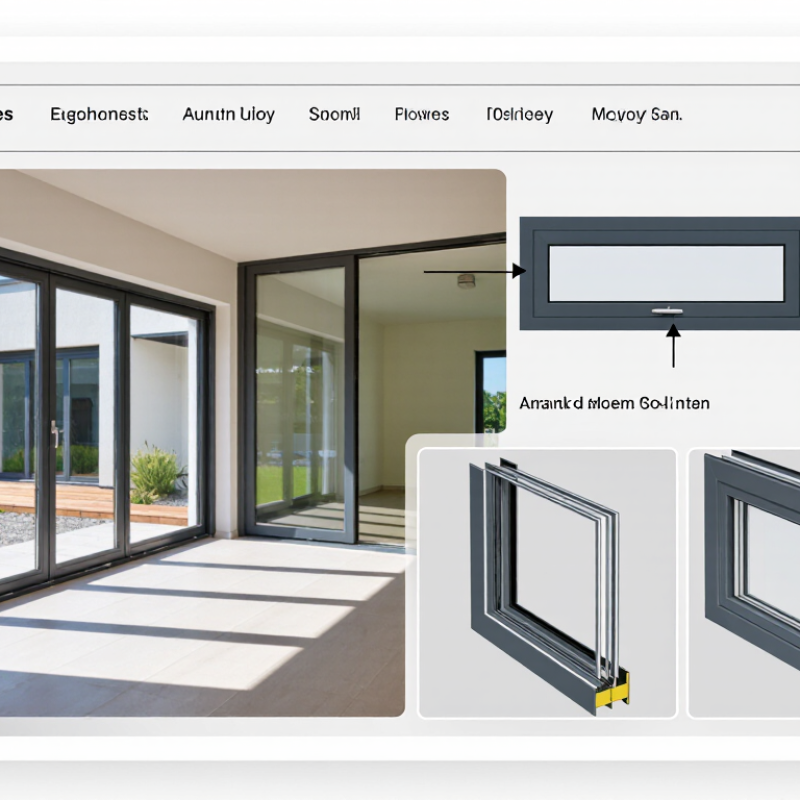
Aluminium’s 2.70 g/cm³ Density and Its Role in Frame Design
Aluminium has a density of about 2.70 g/cm³. For the same solid volume, it weighs less than steel. But window and door frames are not solid blocks. They use hollow extruded profiles, so wall thickness, shape, and reinforcement affect the finished weight. Density is a useful starting point, not a weight estimate by itself.
Designers use internal chambers and ribs to balance stiffness with material use. A well-shaped profile can help support glazing without making every section bulky. Lighter components may be easier to handle during installation. Still, wide doors and large glass panels create real loads. Wind pressure, hardware, and repeated opening all matter. Thermal breaks also need room within the frame, especially where indoor comfort is a concern. The details add up.
On site, frame weight affects lifting, alignment, and fixing choices. Yet density alone cannot predict performance or durability. Alloy, coating, joint design, and maintenance conditions matter too. Ask for profile dimensions and tested performance data, not just a claim that aluminium is lightweight. There is a trade-off. A slimmer frame may look elegant, but it is not automatically the right frame for every opening.
How Thermal Breaks Address Aluminium’s 160–200 W/(m·K) Conductivity
Aluminium is strong, light, and easy to shape, but it conducts heat quickly. Its thermal conductivity is roughly 160–200 W/(m·K), far higher than that of common insulating materials. In a window frame without a thermal break, heat can travel through the metal from indoors to outdoors. On a cold morning, the interior frame may feel chilly and, in some conditions, collect condensation.
A thermal break interrupts that direct route. It places a low-conductivity separator, often a reinforced polymer section, between the inner and outer aluminium profiles. The metal remains visible and structurally useful, while heat transfer through the frame is reduced. It helps. The result depends on the complete assembly, including glazing, seals, frame geometry, and installation quality.
When reviewing a project, ask for whole-window thermal performance data rather than relying on the aluminium’s conductivity alone. Check how the frame connects at corners and around the glass, where small gaps can undermine careful design. A thermal break is not a cure-all; it adds complexity and must be manufactured and installed correctly. Even so, it can make slim aluminium frames more comfortable for everyday use, especially beside a desk or seating area where occupants notice cold surfaces.
Whole-Window U-Factor Ratings: Comparing NFRC and EN Test Methods
When comparing aluminium doors and windows, check whether the quoted U-factor covers the whole window. Glass-only values can look impressively low. They leave out the frame, edge spacer, and other details that influence heat flow through the assembly. Small details matter.
NFRC ratings commonly report U-factor in Btu/h·ft²·°F, while European EN documentation reports whole-window Uw in W/m²·K. The figures describe heat transfer, but their units differ; convert them before comparing. Conversion alone is not enough. NFRC and EN procedures may use different specimen sizes, boundary conditions, and calculation or testing methods. Check the report’s dimensions and confirm it matches the frame, glazing, and opening configuration you are considering.
For aluminium, thermal breaks and frame depth can noticeably affect whole-window performance. Request a current, independently documented rating, rather than relying on a center-of-glass figure. Compare like with like. A lower U-factor generally means less heat transfer, but installation, air leakage, and local climate also shape comfort. A rating table without its test method may still be useful, but it leaves an important gap.
Coatings and Anodizing: Assessing Durability with ISO 9227 Salt-Spray Tests
For aluminium doors and windows, the finish matters as much as the frame. A coating creates a protective surface layer, while anodizing changes the outer layer of the aluminium itself. Both can resist corrosion, but performance depends on preparation, thickness, application quality, and how edges are treated. Small scratches near a handle or exposed cut edge can become weak points.
ISO 9227 salt-spray testing places prepared samples in a controlled chamber with a saline mist. The test helps compare corrosion resistance under repeatable conditions. Inspectors may look for blistering, pitting, or corrosion spreading from a scribed line. A clean result is useful evidence. It is not a promise that a frame will last a specific number of years outdoors.
That distinction is easy to overlook. Salt spray does not reproduce every real exposure, such as changing temperatures, standing water, or airborne grime. Ask for the test method, duration, sample preparation, and inspection criteria—not just a claim that a finish “passed.” Check whether the tested sample included cut edges and hardware contact areas. Those details can change the picture. Real projects are messier than a chamber. A finish should be judged alongside drainage design, installation quality, and the local environment.
Why Choose Aluminium Doors and Windows for Your Project?
Coatings and Anodizing: ISO 9227 Salt-Spray Exposure Checkpoints
The chart shows example exposure checkpoints often specified for corrosion testing, from 24 to 1,000 hours. ISO 9227 defines salt-spray test methods; it does not prescribe one universal exposure duration or directly predict real-world service life. Coating performance should be judged against the project’s specified acceptance criteria.
Recycled Aluminium Uses About 5% of the Energy Needed for Primary Metal
Choosing aluminium doors and windows is partly a material decision—and partly an energy decision. The International Aluminium Institute (IAI) reports a striking difference in its Aluminium Recycling guidance. Recycled aluminium uses about 5% of the energy required to produce primary metal. That is roughly a 95% saving. Primary production involves energy-intensive refining and smelting, while recycling generally remelts sorted scrap. The metal retains its core properties. Worth noting. Not the whole story.
IAI estimates that about 75% of all aluminium ever produced remains in use. This points to durability and recovery potential, not guaranteed recycling for every frame. For a project, request documented recycled-content figures and ask how frames can be separated during refurbishment. Thermal breaks, glazing, seals, and installation quality also shape operational performance; recycled content alone does not make a building efficient. Coatings and mixed components may complicate recovery. That detail can be missed in early specifications.
Why Choose Aluminium Doors and Windows for Your Project? — Recycled Aluminium Uses About 5% of the Energy Needed for Primary Metal
| Dimension |
Primary Aluminium |
Recycled Aluminium |
What It Means for a Project |
| Production energy |
Reference level: 100 |
About 5% of the energy needed for primary aluminium |
Using recycled content can substantially reduce the energy associated with material production. |
| Energy saving |
— |
About 95% less energy than primary production |
A useful comparison when evaluating the environmental impact of frame materials. |
| Density |
Approximately 2.70 g/cm³ for aluminium |
Approximately 2.70 g/cm³ for the same aluminium alloy |
Aluminium’s relatively low density helps enable strong, lightweight frames; the exact design still determines frame weight and strength. |
| Melting point |
About 660°C for pure aluminium |
Re-melted and processed; alloy composition affects melting behavior |
The relatively low melting point supports remelting, though recycling still requires collection, sorting, and processing. |
| Recycling potential |
Can enter recycling streams after use |
Can be recycled repeatedly when appropriately collected and sorted |
Specify recycled content and end-of-life recovery options where these are relevant to the project. |
| Thermal performance of the frame |
Aluminium conducts heat readily |
Recycled content does not by itself make the frame more insulating |
For energy-efficient doors and windows, consider thermally broken frames, glazing, seals, and whole-window performance. |
Notes: The 5% energy figure is a commonly reported industry comparison; actual energy use varies with production route, recycled feedstock, and system boundaries. Material property figures are approximate and can vary by alloy and measurement conditions. Reference sources: International Aluminium Institute, U.S. Geological Survey, and standard aluminium material-property references.
Conclusion
Aluminium Doors And Windows offer a strong yet lightweight framing option, with aluminium’s density of about 2.70 g/cm³ helping support slim profiles and generous glazed areas. Because aluminium conducts heat readily—around 160–200 W/(m·K)—well-designed thermal breaks separate the interior and exterior parts of a frame, reducing heat transfer and improving comfort. When comparing performance, look at whole-window U-factor ratings rather than frame figures alone. NFRC and EN methods use different testing and rating approaches, so results should be compared within the relevant system.
Long-term durability also depends on surface protection and exposure conditions. Coatings and anodizing can help resist weathering, while ISO 9227 salt-spray testing provides a controlled way to assess corrosion resistance; it is useful evidence, though not a direct prediction of service life. Aluminium can also support more resource-conscious projects: recycling it typically uses about 5% of the energy required to produce primary metal. Considering frame design, thermal performance, finish, and recycled content together helps make a balanced choice.