Choosing the right Aluminum Bathroom Door supplier requires more than comparing glossy catalogs. Worldwide buyers need dependable materials, accurate dimensions, stable production, and responsive after-sales support. A bathroom door may face daily moisture, temperature changes, cleaning chemicals, and repeated opening. Small weaknesses can become visible quickly.
This guide examines ten notable suppliers through practical purchasing criteria. These include aluminum alloy quality, surface treatment, hardware durability, customization options, lead times, certifications, and warranty clarity. Supplier experience also matters. Established manufacturers often provide clearer technical drawings, installation guidance, and quality-control records. Still, reputation alone is not enough. Product evidence should support every important claim.
Details matter.
For example, a reliable supplier should explain the frame thickness, coating method, hinge material, glass configuration, and drainage design. Buyers should also check whether the supplier has completed similar projects, such as hotels, apartments, or residential developments. Verified customer feedback can reveal issues that product photographs hide. Delivery performance deserves attention too, especially for projects involving hundreds of doors.
The ranking is not absolute. Regional pricing, shipping conditions, and building requirements can change the result. A supplier that performs well in Europe may not suit a humid coastal project in Southeast Asia. Some companies also publish limited information, making direct verification necessary. This guide therefore combines available business information with practical evaluation points, while recognizing that further inspection may be needed before purchase. Use it as a careful starting point, not a final decision.
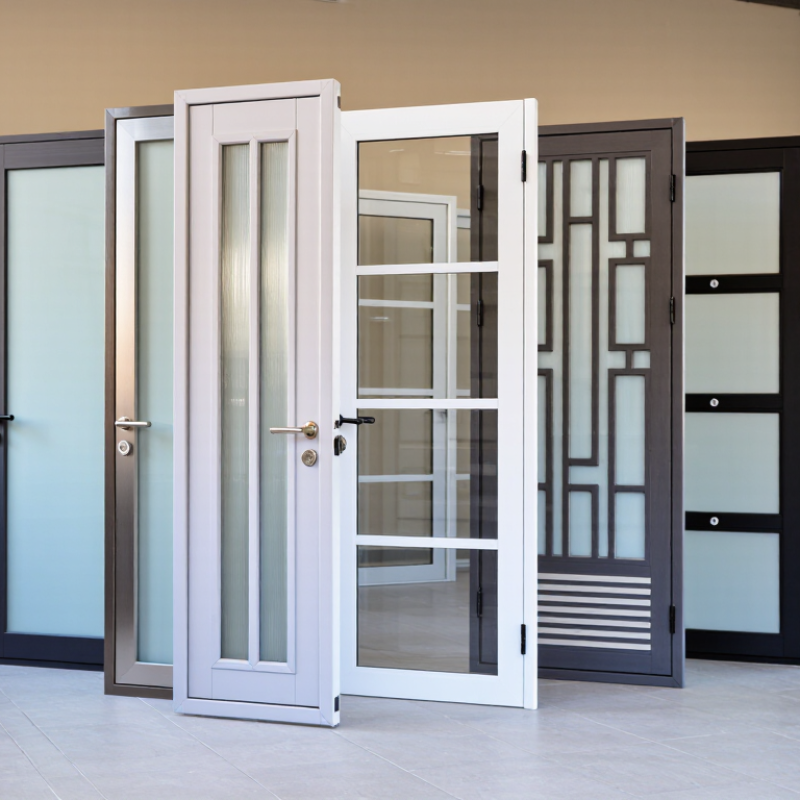
Aluminum bathroom doors use lightweight metal frames with glass, laminate, or waterproof panels. Their structure suits spaces exposed to steam, splashes, and daily cleaning. Unlike untreated wood, aluminum does not swell easily when moisture reaches the frame. That difference matters.
In practical installations, aluminum doors are popular because they are light, stable, and simple to maintain. A powder-coated or anodized surface can resist routine corrosion when applied correctly. Smooth profiles also leave fewer places for soap residue to collect. Many designs support frosted glass, sliding tracks, ventilation gaps, and compact swing openings. These options help bathrooms feel brighter without sacrificing privacy.
However, aluminum is not automatically perfect. Poorly sealed joints may allow water behind the frame. Low-quality hardware can loosen after repeated use. A reliable supplier should identify the aluminum grade, surface treatment, seal material, glass specifications, and load capacity. Ask for installation drawings and sample corners before placing a large order. Check how the door handles uneven floors and frequent cleaning. Small details reveal manufacturing discipline.
Some buyers focus only on price. That can be a costly shortcut. A better comparison includes coating thickness, hinge quality, replacement parts, packaging, and technical support. Suppliers should also explain realistic maintenance needs. Even durable aluminum requires cleaning and periodic inspection. Water still finds weak points.
Aluminum bathroom doors are door systems made from aluminum frames, often combined with glass, acrylic, or waterproof panels. Their low material density, corrosion resistance, and ease of fabrication make them practical for humid bathroom environments.
Chart explanation: Aluminum has a typical density of about 2.70 g/cm³, making it substantially lighter than steel and stainless steel while remaining stronger and more durable than many lightweight polymers. The values shown are representative engineering densities at room temperature and may vary by alloy, grade, moisture content, or product formulation.
Reference basis: typical material-density ranges reported in engineering handbooks and technical material databases, including ASM Handbook and MatWeb.
When comparing the top 10 aluminum bathroom door suppliers worldwide, evaluate evidence rather than attractive catalogs. Check the aluminum alloy, wall thickness, surface treatment, hinge quality, and sealing design. A reliable supplier should provide clear technical drawings, inspection records, and test samples. Ask whether the finish resists humidity, scratches, and corrosion after repeated bathroom use.
Supplier experience matters, but it should be measurable. Review completed projects, production capacity, quality-control procedures, and delivery performance. Request references from similar climates and building types. Confirm packaging details, replacement-part support, warranty terms, and communication response times. A low quotation may exclude installation guidance, export handling, or spare components. That mistake becomes expensive later.
Tips: Order a physical sample before approving bulk production. Inspect corner joints, door alignment, drainage gaps, and the smoothness of sliding or swinging movement. Test the sample in a humid environment when possible. Verify relevant safety and building requirements for your destination market. Certifications can help, but they do not replace inspection. Be cautious with vague promises. A polished presentation can still hide inconsistent tolerances. My practical view is imperfect: supplier rankings offer a starting point, not a final decision. The best choice depends on verified performance, transparent communication, and the actual conditions of your project.
Top 10 Aluminum Bathroom Door Suppliers Worldwide
The top 10 aluminum bathroom door suppliers worldwide should be judged beyond appearance. Reliable suppliers usually provide corrosion-resistant frames, accurate measurements, and stable hardware for humid spaces. Their doors may use powder-coated aluminum, laminated panels, tempered glass, or moisture-resistant boards. Each material affects cleaning, privacy, durability, and price.
A strong supplier should explain alloy grades, coating thickness, hinge quality, drainage gaps, and installation limits. Product drawings and sample approval reduce costly mistakes. Clear information about production capacity, lead times, packaging, and replacement parts also shows professional control. Independent testing can support claims about water resistance, surface adhesion, and hardware performance. However, certificates alone are not enough. Buyers should compare test dates, applicable standards, and actual product specifications.
Bathroom projects often involve uneven walls and limited ventilation. Suppliers with practical installation guidance can handle these challenges better. Ask whether doors can be adjusted on site and whether spare seals are available. A beautiful finish may still fail if water collects beneath the frame. This detail is easy to miss. Some supplier websites look impressive but provide weak technical documents. That should invite careful questions, not immediate rejection. The best choice balances verified quality, responsive communication, regional compliance, and realistic after-sales support. Price matters, but replacing a swollen panel or corroded hinge costs more later.
Leading aluminum bathroom door suppliers offer more than standard door panels. Their product ranges often include sliding, hinged, folding, and frameless-style systems. Common options include anodized or powder-coated aluminum frames, frosted glass, clear tempered glass, waterproof seals, and stainless-steel hardware. Some suppliers also produce custom sizes for compact apartments, hotels, and accessible bathrooms.
Reliable suppliers usually provide technical drawings, sample finishes, measurement support, and installation guidance. Experienced teams can recommend frame thickness, hinge capacity, drainage gaps, and suitable glass combinations. Quality checks may cover coating adhesion, door alignment, seal performance, and repeated opening tests. Export services often include protective packaging, container loading, and documentation support. However, service quality can vary between regions. A supplier may offer excellent products but weak after-sales communication. That detail deserves attention.
Tips: Ask for material grades, coating specifications, test reports, and warranty terms. Request a physical sample when possible. Check whether replacement seals and hardware remain available after installation. Compare the supplier’s stated tolerances with your site measurements. A two-millimeter mistake can create noticeable water leakage. Do not judge quality from photographs alone. Examine corner joints, glass edges, handle movement, and the frame’s surface under bright light. Leading suppliers should answer technical questions clearly, not hide behind attractive catalogs. A careful comparison may take longer, but it reduces costly adjustments later.
| Rank | Supplier Profile | Primary Market Region | Key Aluminum Door Products | Core Services | Common Materials & Glazing | Surface Finish Options | Customization Capability | Typical Lead Time | Typical Documentation |
|---|---|---|---|---|---|---|---|---|---|
| 1 | Profile A — Integrated Manufacturer | East Asia; export-focused | Sliding, hinged, folding, and shower enclosure doors | Design engineering, extrusion, fabrication, glazing, packaging, and export logistics | 6063-series aluminum profiles; tempered, laminated, or frosted safety glass | Anodizing, powder coating, wood-effect coating, and PVDF coating | High; custom sizes, hardware, colors, glass patterns, and opening configurations | 25–45 days for standard export orders | Drawings, packing list, test reports, coating specifications, and origin documents |
| 2 | Profile B — Architectural Systems Supplier | Western Europe; regional and project supply | Slim-frame bathroom doors, partition doors, and wet-room systems | Architectural specification support, shop drawings, system consultation, and project coordination | Aluminum alloy frames; safety glass, compact laminate, and moisture-resistant panels | Anodized aluminum, textured powder coating, and custom RAL colors | High; coordinated frame depths, thresholds, seals, and accessibility details | 4–10 weeks depending on project approval | System data sheets, installation manuals, declarations, and performance information |
| 3 | Profile C — OEM and Private-Label Specialist | Southeast Asia; international OEM supply | Aluminum-framed shower doors, vanity doors, and compact bathroom partitions | OEM development, private-label packaging, sample production, and quality inspection | 6063 aluminum; clear, grey, bronze, acid-etched, and laminated glass | Powder coating, anodizing, and electroplated hardware finishes | High; logo-free or private-label packaging, hardware selection, and retail dimensions | 30–60 days for new or customized items | Approved samples, inspection records, carton specifications, and commercial documents |
| 4 | Profile D — Premium Residential Door Fabricator | North America; residential and remodeling channels | Custom hinged doors, barn-style sliding doors, and frameless glass bathroom doors | Site measurement, design consultation, fabrication, and installation coordination | Extruded aluminum; tempered safety glass and moisture-resistant composite inserts | Anodized, satin, matte black, white, and custom powder-coated finishes | Very high; made-to-measure dimensions and project-specific hardware | 3–8 weeks after final site measurements | Installation drawings, glass specifications, warranty terms, and care instructions |
| 5 | Profile E — Commercial Washroom Systems Supplier | Middle East; hospitality and commercial projects | Toilet cubicle doors, shower cubicles, wet-area partitions, and service doors | Project take-offs, layout planning, site coordination, delivery, and installation support | Aluminum frames; compact laminate, glass, and waterproof panel infills | Powder-coated aluminum, anodized finishes, and corrosion-resistant hardware | Medium to high; optimized for repeated commercial layouts | 6–12 weeks for contract projects | Shop drawings, material schedules, installation method statements, and maintenance guides |
| 6 | Profile F — Modular Bathroom Manufacturer | East Asia; modular construction supply | Prefabricated bathroom pods, aluminum doors, and integrated shower-room modules | Module engineering, assembly, water-management coordination, and batch delivery | Aluminum profiles; tempered glass, FRP, compact laminate, and waterproof boards | Powder coating, anodizing, and easy-clean protective treatments | Medium; customization is usually based on approved modular platforms | 8–16 weeks for production batches | Module drawings, material lists, assembly instructions, and quality-control records |
| 7 | Profile G — High-Humidity and Coastal Applications Supplier | Oceania and coastal markets | Marine-grade bathroom doors, pool-area doors, and corrosion-resistant shower systems | Material selection, corrosion-risk assessment, fabrication, and replacement-part support | Aluminum profiles; laminated or toughened safety glass; stainless-steel hardware | Anodizing and powder coating selected for humid or salt-air environments | High; seal design, drainage details, hardware upgrades, and nonstandard sizes | 4–9 weeks for standard custom orders | Coating data, hardware specifications, care instructions, and installation details |
| 8 | Profile H — Retail and Stock-Size Distributor | Central and Eastern Europe; retail distribution | Standard shower doors, bath screens, sliding doors, and replacement panels | Inventory management, retail packaging, spare parts, and technical customer service | Aluminum frames; tempered safety glass and standard waterproof seals | White, silver, chrome-effect, black, and common anodized finishes | Low to medium; primarily stock sizes with limited color selection | 2–10 business days for stocked products | Product catalogs, assembly manuals, packaging labels, and warranty information |
| 9 | Profile I — Hospitality and Healthcare Specialist | Northern Europe; institutional projects | Accessible bathroom doors, anti-ligature doors, shower doors, and service partitions | Compliance-oriented design, mock-ups, project approvals, and installation supervision | Aluminum frames; safety glass, compact laminate, and hygienic solid-surface panels | Durable powder coating, anodized finishes, and easy-clean surface options | High; accessibility clearances, privacy requirements, and controlled hardware options | 8–14 weeks for approved contract specifications | Accessibility details, cleaning instructions, material declarations, and project submittals |
| 10 | Profile J — Sustainable and Recycled-Aluminum Supplier | Western Europe and selected global projects | Low-carbon aluminum bathroom doors, partition systems, and circular refurbishment components | Environmental documentation, design optimization, take-back planning, and project consultancy | Primary or recycled aluminum; tempered glass, recycled-content panels, and replaceable components | Anodizing, powder coating, and low-VOC coating systems | Medium to high; component replacement and disassembly are prioritized | 5–12 weeks depending on recycled-content and finish requirements | Environmental product information, recycled-content declarations, material data, and maintenance guides |
Note: The supplier profiles are anonymized benchmark categories. Lead times, materials, finishes, documentation, and customization levels are representative industry ranges and should be verified against project-specific quotations and technical submittals.
Choosing among the top aluminum bathroom door suppliers requires more than comparing catalog prices. Start with the project conditions: wet-room exposure, opening size, traffic frequency, privacy requirements, and installation method. Request aluminum alloy details, coating thickness, hardware specifications, and tested load performance. A supplier should provide clear drawings, sample corners, tolerance data, and realistic lead times. Visit a production site when possible. Small details matter, such as drainage holes, concealed fixings, and how the bottom rail meets a sloped floor.
Sustainability should be measured, not promised. The International Aluminium Institute reports that recycled aluminum uses about 5% of the energy required for primary aluminum production. Ask suppliers for recycled-content evidence, chain-of-custody records, and coating declarations. The 2024 Global Status Report for Buildings and Construction identifies buildings as responsible for roughly 32% of global energy use and 34% of energy-related emissions. A durable door can reduce replacement waste, but only if hinges, seals, and finishes are serviceable.
Evaluate quality-control records before signing. Check independent test reports for corrosion resistance, water exposure, finish adhesion, and repeated opening cycles. Confirm whether testing matches your region’s building requirements. Ten quotations can still hide ten different specifications. That is the difficult part. Compare complete installed cost, not only the door leaf. One weakness remains: supplier documents may look precise while excluding packaging damage, installation errors, or warranty limits. Put those risks in writing, and ask for a corrective-action process with response times.
They usually combine lightweight aluminum frames with glass, laminate, or waterproof panels. Smooth profiles reduce places where soap residue collects. Details matter.
Aluminum resists swelling better than untreated wood when exposed to moisture. It also remains light during daily opening and cleaning. Water still finds weak points.
No. Poorly sealed joints may let water behind the frame. Check seals, drainage holes, bottom rails, and corners before installation.
Frosted glass provides privacy while keeping the room brighter. Sliding tracks save space, and ventilation gaps support airflow. Compact swing openings suit narrow layouts.
Request the aluminum grade, coating type, coating thickness, seal material, glass details, and load capacity. Ask for drawings, tolerance data, and sample corners.
Compare the complete installed cost, not only the door price. Include hardware, packaging, replacement parts, installation, technical support, and warranty limits. A low quote can look attractive.
Review corrosion, water-exposure, finish-adhesion, and repeated-cycle test reports. Visit the production site if possible. Small defects can become expensive.
Recycled aluminum may use about five percent of primary production energy. Ask for recycled-content evidence and supply-chain records. Sustainability claims need proof.
Clean surfaces regularly and inspect hinges, seals, tracks, and fixings. Durable materials still need service. This method is not perfect, but it prevents surprises.
Aluminum Bathroom Door systems are widely used because they combine lightweight construction, moisture resistance, durability, and modern visual appeal. They are suitable for homes, hotels, offices, and commercial facilities where frequent exposure to humidity requires reliable performance. This article explains the main features of aluminum bathroom doors, including frame design, glass or panel options, hardware quality, surface finishes, ventilation, safety, and ease of maintenance.
It also presents a practical approach to evaluating suppliers worldwide by considering manufacturing capability, product consistency, customization options, certifications, communication, lead times, packaging, installation support, and after-sales service. The overview of the top ten supplier categories highlights the products and services commonly offered, such as sliding, hinged, folding, and customized door systems. Finally, readers will learn how to compare suppliers according to project requirements, budget, climate, design preferences, technical standards, and long-term service reliability before making a suitable purchasing decision.