Choosing an Aluminium Sliding Window supplier is more than comparing catalogue prices. Global buyers must judge product performance, manufacturing consistency, delivery capability, and after-sales support together. A slim frame may look attractive in a showroom, yet perform differently when exposed to coastal air, strong wind, or frequent temperature changes.
This guide introduces ten suppliers for buyers seeking options across international markets. It considers practical details such as aluminium alloy, surface finish, thermal-break design, glazing choices, rollers, locks, drainage, and available size ranges. Details matter. Ask suppliers for current product specifications, relevant test reports, sample or project references, warranty terms, and clear lead-time estimates. These records help buyers compare claims with evidence, rather than relying on polished photographs or broad promises.
No single supplier fits every project. Climate, building design, installation methods, budget, and local performance requirements can change what “best” means. Not every project needs the same frame or glass package. A supplier experienced with large commercial orders may not be the right choice for a small residential renovation. One limitation of any top-ten list is that rankings cannot capture every buyer’s site conditions or service expectations. Treat the companies below as a starting shortlist, then confirm details directly with each supplier. A careful comparison takes time, but it can prevent costly mismatches after the windows arrive.
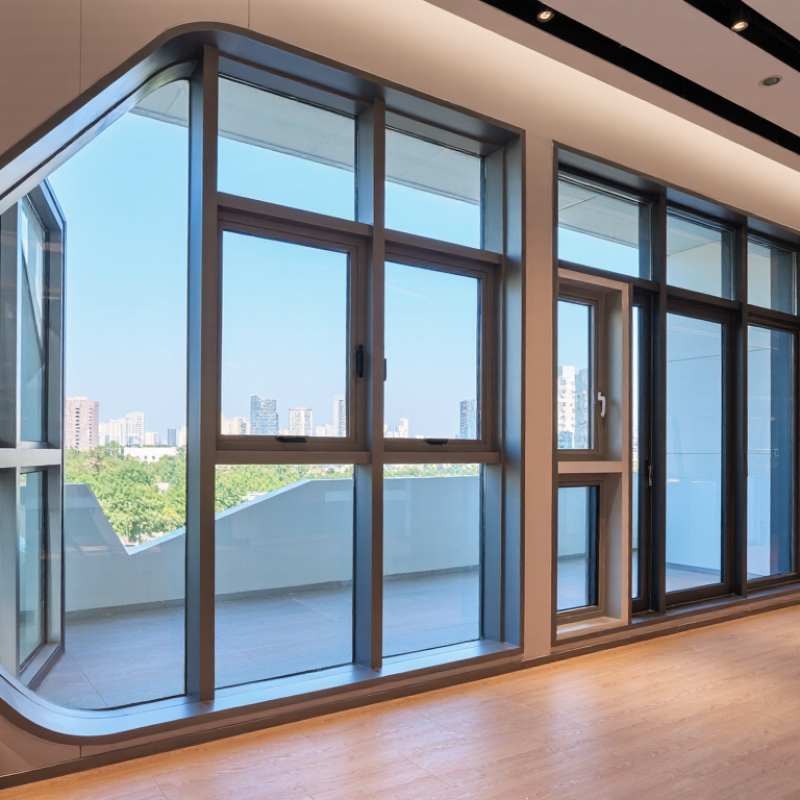
Aluminium Sliding Windows: 160–200 W/(m·K) Conductivity and the Role of Thermal Breaks
Aluminium Sliding Windows: 160–200 W/(m·K) Conductivity and the Role of Thermal Breaks
Aluminium conducts heat readily, typically around 160–200 W/(m·K), depending on the alloy. That makes an unbroken frame an easy route for heat to move between indoors and outdoors. On a cold morning, the room-facing metal can feel chilly. Condensation may also appear when indoor air is humid. Small details matter.
A thermal break separates the exterior and interior aluminium sections with a low-conductivity material, often a polyamide strip. It slows heat transfer through the frame, but does not stop it completely. Strip width, profile design, glazing, seals, and installation all affect the finished window’s performance. Compare whole-window U-values, not just frame claims; Uf describes the frame, while Uw includes the complete window. I would not treat one figure as the whole story.
Tips: Ask for tested whole-window data and check the stated size and glazing configuration. Inspect sample corners for continuous seals and a clearly separated thermal break. Also consider local climate and condensation risk. A warmer frame helps, but poor installation can undo part of the gain.
How to Assess Suppliers Against EN 14351-1 and ISO 10077-1
EN 14351-1 helps buyers compare declared window performance, but a certificate alone is not enough. Ask suppliers for test reports tied to the exact sliding-window configuration: frame profile, sash size, glazing, seals, and locking hardware. Check air permeability, watertightness, and wind-load results, and confirm the tested specimen resembles the product you plan to order. A wide two-panel unit may perform differently from a compact sample. Look for clear, traceable documentation. Paperwork can be messy.
For thermal performance, ISO 10077-1 provides a calculation method for the window’s heat transfer. Request the whole-window Uw value, not just the center-of-glass Ug figure. The calculation should reflect the aluminum frame, thermal break, glazing, spacer, and stated dimensions. Ask how the value was derived and whether the report covers your chosen build. Small changes matter. Installation also affects real-world comfort, though it is not captured by the product’s calculated Uw alone. Compare like with like, and treat unusually low values cautiously if assumptions are missing. I would still want to see the underlying inputs; summaries can leave important gaps.
Top 10 Aluminium Sliding Window Suppliers: Markets, Products, and Capabilities
Top 10 Aluminium Sliding Window Suppliers: Markets, Products, and Capabilities
Aluminium sliding window suppliers serve residential, commercial, and renovation markets, but their strengths can differ by region. Some focus on large project orders, while others offer more flexible sizing for custom homes. Climate matters. Coastal projects may need corrosion-resistant finishes, while colder regions often prioritize thermal breaks and insulated glazing. Buyers should check which specifications are standard and which require upgrades.
Product ranges can include two- or three-track frames, slim sightlines, fly screens, and different glass thicknesses. Smooth operation depends on more than appearance: rollers, drainage paths, frame rigidity, and installation tolerances all matter. Ask for technical drawings and test reports that match the proposed configuration. A test result for one size or glass option may not apply to every window.
Manufacturing capacity, quality checks, packaging, and export support also shape supplier suitability. Request details on lead times, replacement parts, installation guidance, and how defects are handled. Samples can reveal finish quality, but one sample cannot prove consistent production. Comparisons are rarely perfect; specifications and service promises may use different assumptions. Buyers should record those gaps before making a decision.
Compare U-Factor, Air Leakage, Water Resistance, and Wind-Load Ratings
Buyers comparing aluminium sliding windows should treat performance ratings as a set, not a shopping checklist. A low U-factor indicates better resistance to heat transfer, but frame size, glazing, spacers, and test conditions can change the result. Check whether figures describe the complete window or glass alone. That difference matters.
Air leakage ratings show how much air passes through a tested assembly at a stated pressure. Lower leakage can improve comfort near a windy façade. Water-resistance ratings describe the pressure reached before water enters during testing; they cannot guarantee a dry opening if flashing or drainage is poorly installed. Wind-load ratings should suit the building’s height, local exposure, and window size. Ask for reports from accredited testing facilities, and compare products tested under the same method. Not always easy.
Tips: Request the exact configuration, including glass, locks, and dimensions. Confirm U-factor and leakage units before comparing quotes. Ask how sill drainage and perimeter sealing will work on site, and keep the answers in writing.
Top 10 Aluminium Sliding Window Suppliers for Global Buyers — Compare U-Factor, Air Leakage, Water Resistance, and Wind-Load Ratings
| Anonymous Profile |
U-Factor
(Btu/h·ft²·°F) |
Air Leakage
(cfm/ft² at 1.57 psf) |
Water Resistance
(psf / kPa) |
Wind-Load Design Pressure
(psf / kPa) |
Buyer Check |
| Profile 01 |
0.20 |
≤ 0.10 |
12 / 0.57 |
60 / 2.87 |
Request reports for the exact frame, glass, and operating configuration. |
| Profile 02 |
0.22 |
≤ 0.10 |
10 / 0.48 |
50 / 2.39 |
Confirm the tested maximum sash size and hardware specification. |
| Profile 03 |
0.24 |
≤ 0.15 |
10 / 0.48 |
50 / 2.39 |
Check whether the stated pressure applies to the project’s building height and exposure. |
| Profile 04 |
0.25 |
≤ 0.15 |
8 / 0.38 |
45 / 2.15 |
Verify drainage details and the water-test method in the laboratory report. |
| Profile 05 |
0.27 |
≤ 0.20 |
8 / 0.38 |
40 / 1.91 |
Confirm that performance covers the selected glazing and insect-screen options. |
| Profile 06 |
0.28 |
≤ 0.20 |
7 / 0.34 |
40 / 1.91 |
Ask for air-leakage results at the same test pressure used for comparison. |
| Profile 07 |
0.30 |
≤ 0.25 |
7 / 0.34 |
35 / 1.67 |
Check local code requirements and the project’s specified design pressure. |
| Profile 08 |
0.31 |
≤ 0.25 |
6 / 0.29 |
35 / 1.67 |
Confirm that the tested unit matches the proposed frame depth and installation method. |
| Profile 09 |
0.33 |
≤ 0.30 |
6 / 0.29 |
30 / 1.44 |
Request product-specific certification and current test documentation. |
| Profile 10 |
0.35 |
≤ 0.30 |
6 / 0.29 |
30 / 1.44 |
Compare the complete window assembly, not glass-only or frame-only data. |
Data note: These anonymous profiles are illustrative procurement benchmarks, not verified ratings for actual suppliers or products, and they are not a ranked supplier list. Do not use them as product claims or for code compliance.
For a valid comparison, obtain test reports for the exact window configuration and check the applicable local requirements. U-factor is better when lower; air leakage is better when lower; water resistance and design pressure must meet or exceed project requirements. Test procedures and rating labels vary by market.
Verify Factory Quality, Lead Times, Warranties, and Export Readiness
A polished sample can hide uneven production. Samples are not enough. Ask how the factory checks frame dimensions, corner joints, coating thickness, drainage paths, and hardware fit. Request recent inspection records and batch traceability, then compare them with the specification you approved. If possible, inspect units from active production, not only a showroom display. A neat report helps, but it does not replace clear questions.
Lead times should separate fabrication, packing, and ocean or land transit. Ask for a dated production schedule, monthly capacity, and a plan for peak-season delays. Delays happen. Confirm how changes to glass, finish, or order quantity affect the schedule. Review the warranty in writing: check its term, covered components, exclusions, and the process for reporting defects. A broad promise is less useful than a specific remedy and response timeline.
Export readiness involves more than loading a container. Verify that the supplier can prepare accurate commercial documents, protective packaging, product labels, and spare hardware suited to your order. Request photos of packed windows and ask how corners and glass edges are protected. Where appropriate, review redacted shipment records or contactable trade references. It is tempting to trust a confident sales conversation; I would still verify each claim against records. Some uncertainty remains, so keep specifications, approvals, and delivery milestones documented.
Top 10 Aluminium Sliding Window Suppliers: Buyer Evaluation Priorities
Suggested weighting for comparing suppliers—not measured ratings or market data.
Use these weights as a starting point when assessing suppliers. Verify factory quality through audits and inspection records; confirm lead times in written production schedules; review warranty terms; and check export documentation, packaging, and shipping experience. Apply the same evidence-based checklist to each supplier.
Conclusion
This guide helps global buyers evaluate an Aluminium Sliding Window and the suppliers behind it. Because aluminium conducts heat at approximately 160–200 W/(m·K), thermal breaks can play an important role in reducing heat transfer and improving a window’s overall thermal performance. Buyers should also understand how standards such as EN 14351-1 and ISO 10077-1 relate to product testing, declared performance, and U-factor calculations.
The comparison of ten supplier types considers their markets, product ranges, manufacturing capabilities, and export experience. It explains how to assess U-factor, air leakage, water resistance, and wind-load ratings in relation to project requirements, rather than relying on a single headline specification. Before making a purchase, buyers should verify factory quality controls, realistic lead times, warranty terms, documentation, and readiness to handle international orders.